Christine Prescott: Tear Out Your Art

Christine Prescott in Westport, Ireland , 2016. (Photo: C Thompson)
It is said that she plants them in sand to feed what crawls and creeps under it. It is said that she collects the very beautiful – a luminous squid, a sailor with thick gold hair, blue eyes and a lapis earring, an errant sea snake – and arranges them in a weed garden, for the pleasure of staring. Those who see her see nothing else, and do not return to describe her.
AS Byatt, 2011, Ragnarok: The End of the Gods’, p. 21
Christine Prescott is a maker of unusual things. The Australian formally trained sculptor mines the internal realms and manifests poetic forms that speak of the essential emotional terrain. Utilising organic materials such as dried fruits and vegetables, wine, bones, hair and wood, her delicate assemblages, photographs, drawings and paintings are deeply personal and immediately felt.
An artist like those before her, such as Louise Bourgeois, Eva Hesse, Frida Kahlo, Ana Mendieta and Fiona Hall, Prescott combines anecdotal declarations of enchantment and dispossession with intricately constructed material medleys that emerge like votive invocations inviting her audience into her unique world.
She refers to her own practice as ‘ritual, fact and mutterings … the mutterings of things that do not exist or only exist elsewhere’ and ‘I relocate the lost thing and go to the trouble of renaming it, only to have to lose it again’.
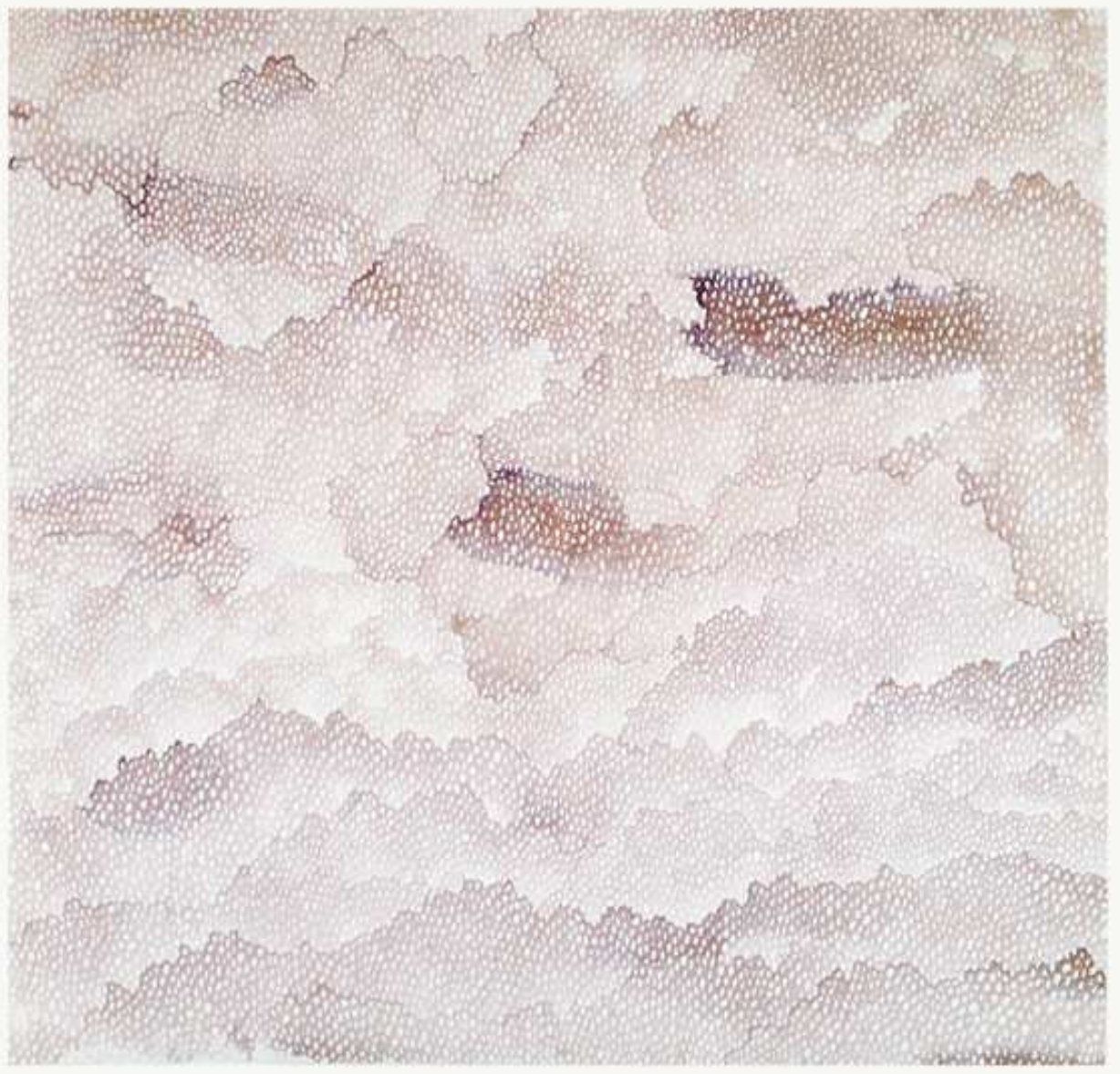
Christine Prescott, Skinn of Brown Snake III, 2014
Prescott acts like an interpreter in Skin of Brown Snake III, 2014; she transmogrifies the seductive, shimmering surface of the brown snake – a memory from her childhood, growing up on a station in the Queensland outback – into a painstaking ephemeral drawing of wine on paper that, like the skin of the brown snake, changes over time.
Prescott’s visions of past, present and future coalesce into magical incarnations merging carefully selected materials that speak an aesthetic language cultivated by her practice which has spanned over a decade.
In Sun Bleached Bones Baked with Heat, 2006, a stem of ghostly white eucalyptus gum peaks into a dried kangaroo paw bound with beeswax and the hair of a poet. She declares: ‘They are fetish objects imbued by the spirit of the materials they have been crafted from, each with its own inherent power, language and history’.
In her work, she draws from the natural world and she mimics its processes, reworking materials such as garlic skins, suturing them together with human hair into a baby cradle, the skins behaving like the peeling layers of paperbark trees. Her practice is indicative of place, evoking the ebb and flow of the natural world as her constant palette and inspiration for her dream-like work.
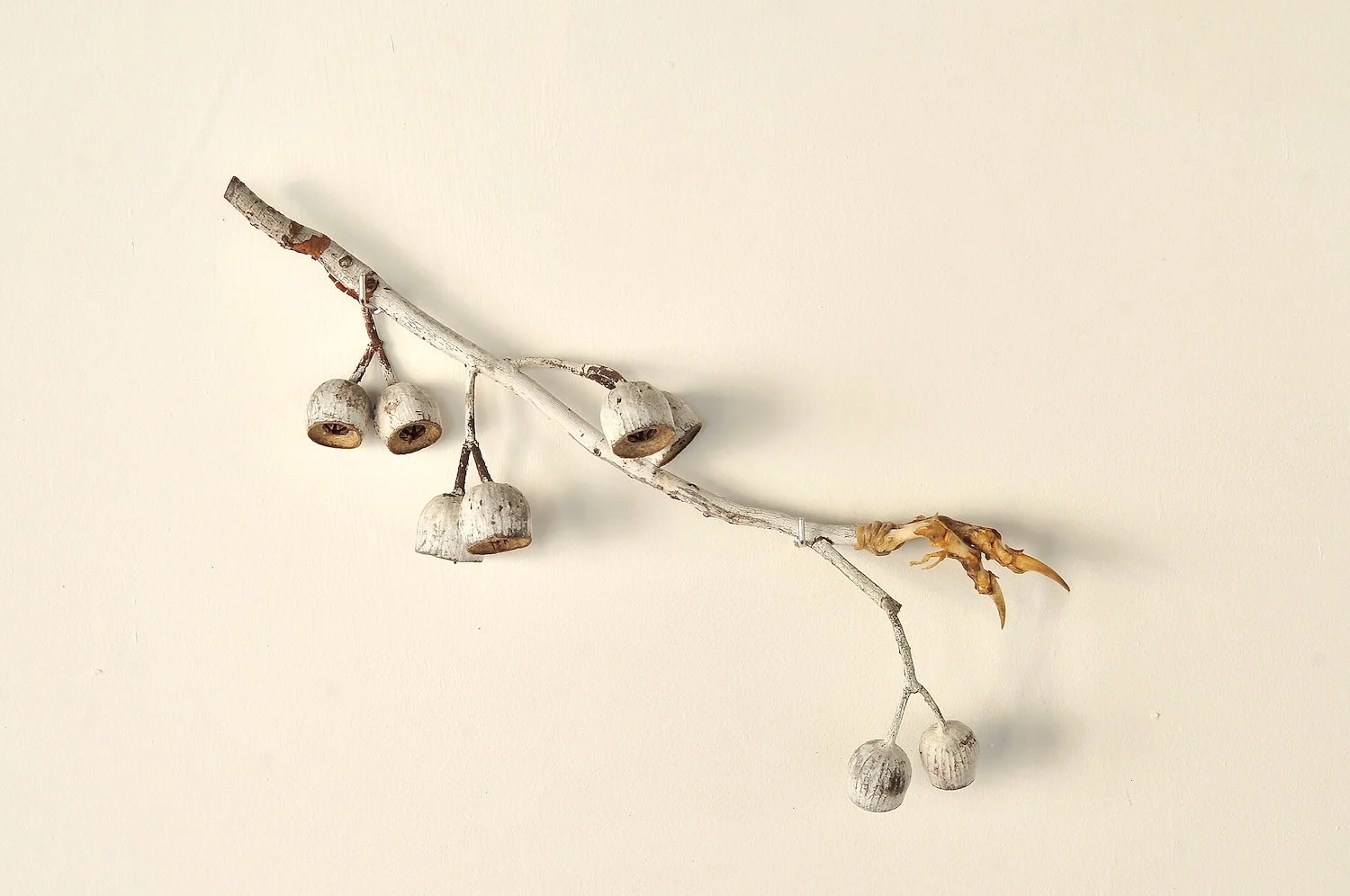
Christine Prescott, Sun Drenched Bones Baked with Heat, 2006
Things of the Dirt, 2004, is an impressive sculpture, appearing like a tree in the gallery space. Upon closer inspection the work is embedded with captivating details – constructed of eucalyptus bark, human hair, beeswax, gelatin capsules, sheep ribs, chicken wire and strawberries – and is a love song to home, a yearning for the arid dry regions of the artist’s memories. She delves into an investigation of who has a right to be in these territories, what is feral and what is native, and the conjuring of the battle of lands.
Ocean Song (Those Who Go Down to the Sea Tell Its Pearly Story), 2002, is a carcass-like form in which sheep ribs form an interior skeleton bonded with human hair and beeswax, over which a veil of dried strawberries sewn together with human hair canopies the bone armature. Sweet fruit flesh melts aged ghost-like bones.
Prescott’s installations hark of something dead and simultaneously imbued with subtle murmurs of life. She delights in this tension between the two, her works like an unseen narrative of nature she redeems what is lost and resuscitates it in the stark atmosphere ofthe contemporary gallery space. Speaking more broadly about her practice Prescott elucidates, claiming:
‘I perpetuate the mourning process. his is an art utterly motivated by the lost thing; driven by the desire to grasp it, to know it … the new form seeming only to bind itself to mortality, like a homing device’.
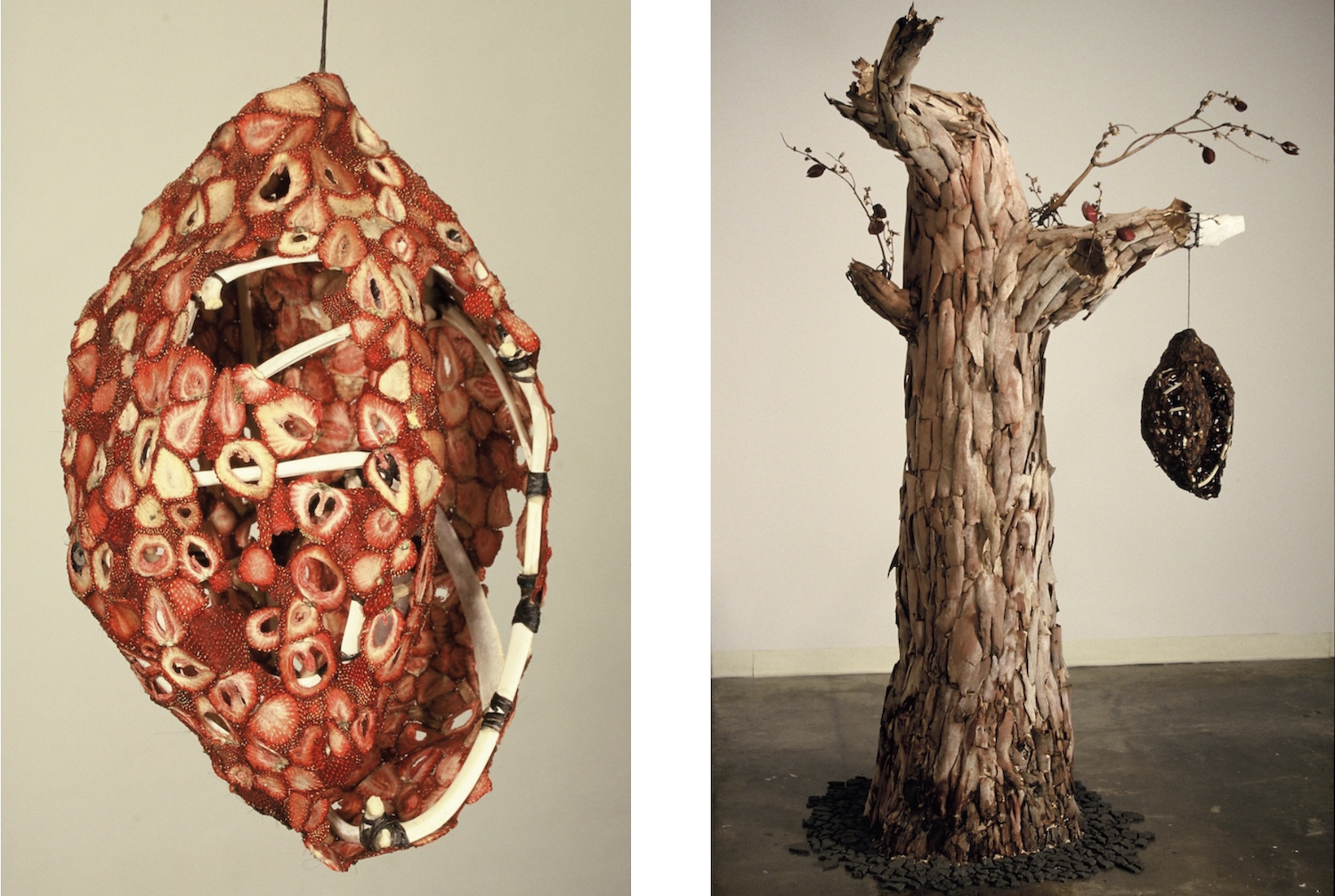
Christine Prescott Ocean Song; (Those who go down to the sea tell its pearly story), 2002,. and Things of the Dirt (tree), 2004
Prescott is a compelling Australian artist, her work resonating so poignantly with the now. As human beings are starting to feel the real impacts of a changing climate, Prescott’s work inhabits and speaks of the very delicate, vulnerable balance between man and nature. In the Cure and the Cause, 2013, the artist brings together a lone dried strawberry placed neatly on a piece of driftwood retrieved from the Irish coastline – vivid and powerful in its simplicity, one object slowly retreats yet the other emerges from the rapturous ocean, reconfigured and reshaped by the tumultuous elements from its previous form. She ponders this work by stating:
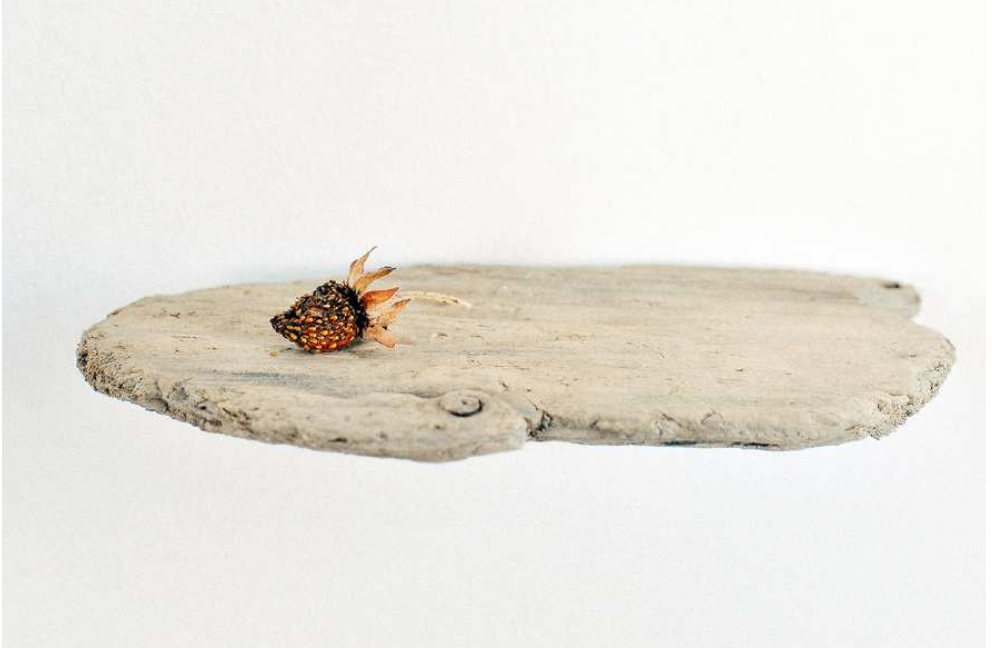
Christine Prescott, The Cause and the Cure, 2013
‘Tools of attack and defence – weak tools; futility disguised as purpose, disease masked by vigour, and decay by beauty’.
She brings to the fore the feelings of nature, the voice that nature is unable to articulate, and the deeply entwined relationship between human as animal informed by his/her environment, which has been diminished by capitalism and the industrial age. She embroiders the language of nature and injects her own whimsical tales that themselves generate more images in the mind of the viewer.
In Things of the Dirt (sun), 2004, Prescott creates a map of the Murray Darling Basin at the end of a drought, out of a paper base and the impression of the river system, which begins in Queensland and completes its journey in Victoria, a path travelled by the artist who now resides in Westport, Ireland. The precision-laid chilli seeds decorate the paper dome’s surface and echo the aerial view of the elaborate and vital river system. ‘It holds a frightened beauty still capable of sustaining hope.
Much like the words of AS Byatt, Prescott’s practice is ethereal, illusory and dream-like, weaving together the depths of the subconscious realms with the poetic observances of nature into inspiring convergences never before seen.
Dr Christian Thompson AO is a contemporary Australian artist, and at the time of this article was the inaugural Charlie Perkins Scholar, University of Oxford. Originally published in 2016 by The Creators Project: http://thecreatorsproject.vice.com/en_au/blog/christian-thompson-christine-prescott.