Finding Home
Alannah Robbins talks to Christine Prescott in the lead up to her new solo exhibition
When Christine Prescott moved to Ireland from Australia twenty years ago, there had been 15 years of drought in her dry, arid homeland of St George, SW Queensland. In that move halfway around the world, she moved from a hyper-awareness of the use of every drop of water to the abundance of rain which just kept coming. ‘The first recording I sent home was one of the rain, the beautiful sounds of the rain’, she says, ‘I was here for three years before I got sick of it.’
This is the conversation which serves as the red thread, through Christine’s work. It is the dialogue between the dry, flat Australia, ‘the land of drought and flooding rains’, and the wetness of the West of Ireland, where ‘you can’t sit down anywhere for the dampness’. The body of work is both vehicle and witness to Christine’s ongoing practice of finding her home. It is a body of meditative, repetitive processes. It touches on themes of migration, relationship with place, reciprocity and the antithesis of reciprocity, colonialism.
Christine is the daughter of an irrigation farmer, who farms cotton, wheat and cattle in SW Queensland, in a land so parched it is hard for us to imagine here in this waterlogged corner of the world. She speaks of the dry cracked earth of her childhood, when, as children, they pretended that the oily black dried mud was chocolate. The materiality of her work speaks of the textures of that dry, parched place, so it surprising to peel back the layers and understand that the materials are almost all Irish.
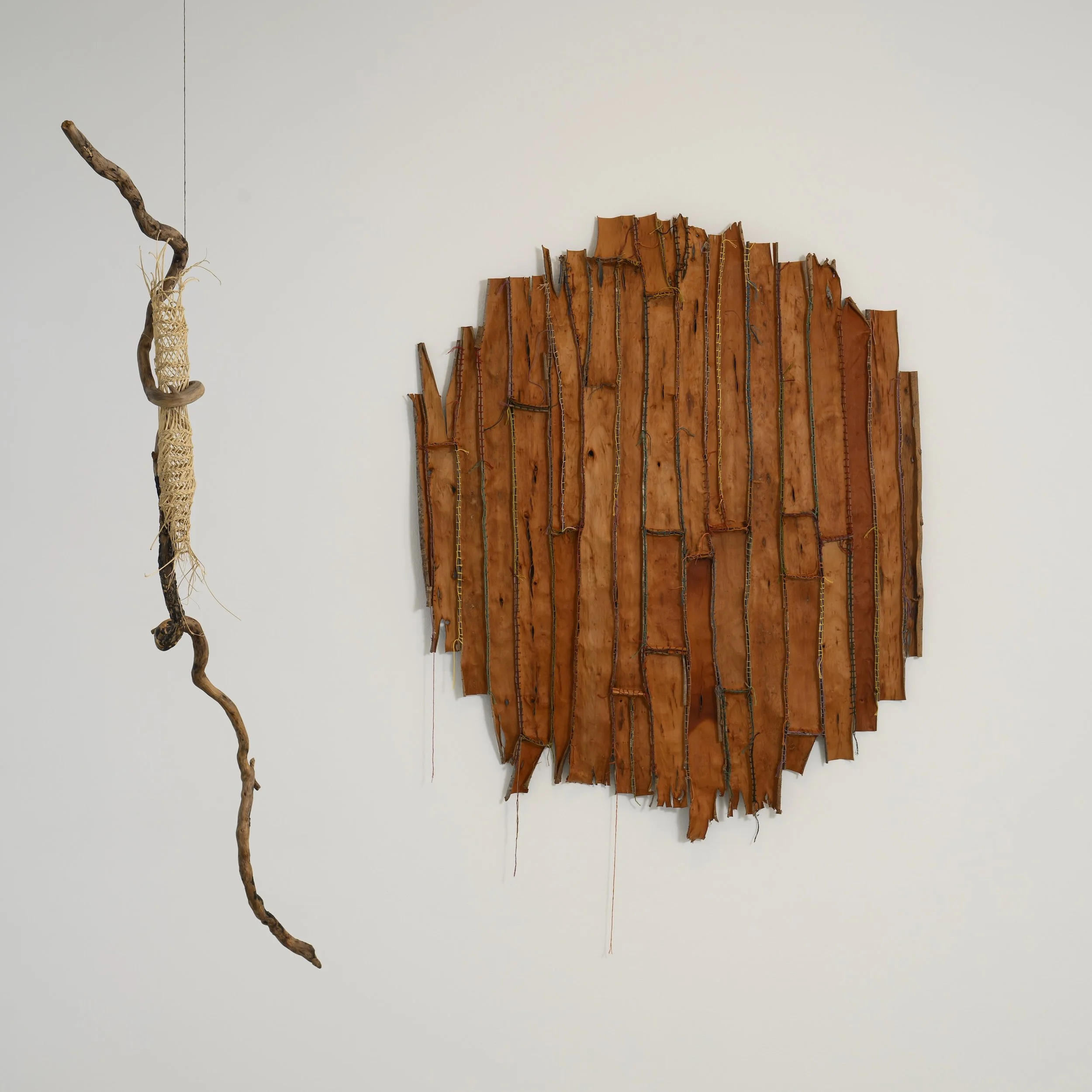
Let’s Dance, 2025, ivy wood and esparto grass; Find Some Things To Love, 2025, willow bark and cotton thread, photograph by Micheal McLaughlin
One exception to this is Esparto grass. Archaeological evidence reveals its use as early as the Neolithic period, with 7,000-year-old esparto sandals and baskets discovered in a cave in southern Spain. In Let’s Dance, Christine has combined Esparto grass with ivy wood, using a neolithic braiding process, similar to that which we use for our hair, only reversed. Suspended from the ceiling, the ivy and the Esparto grass twirl in the room together.
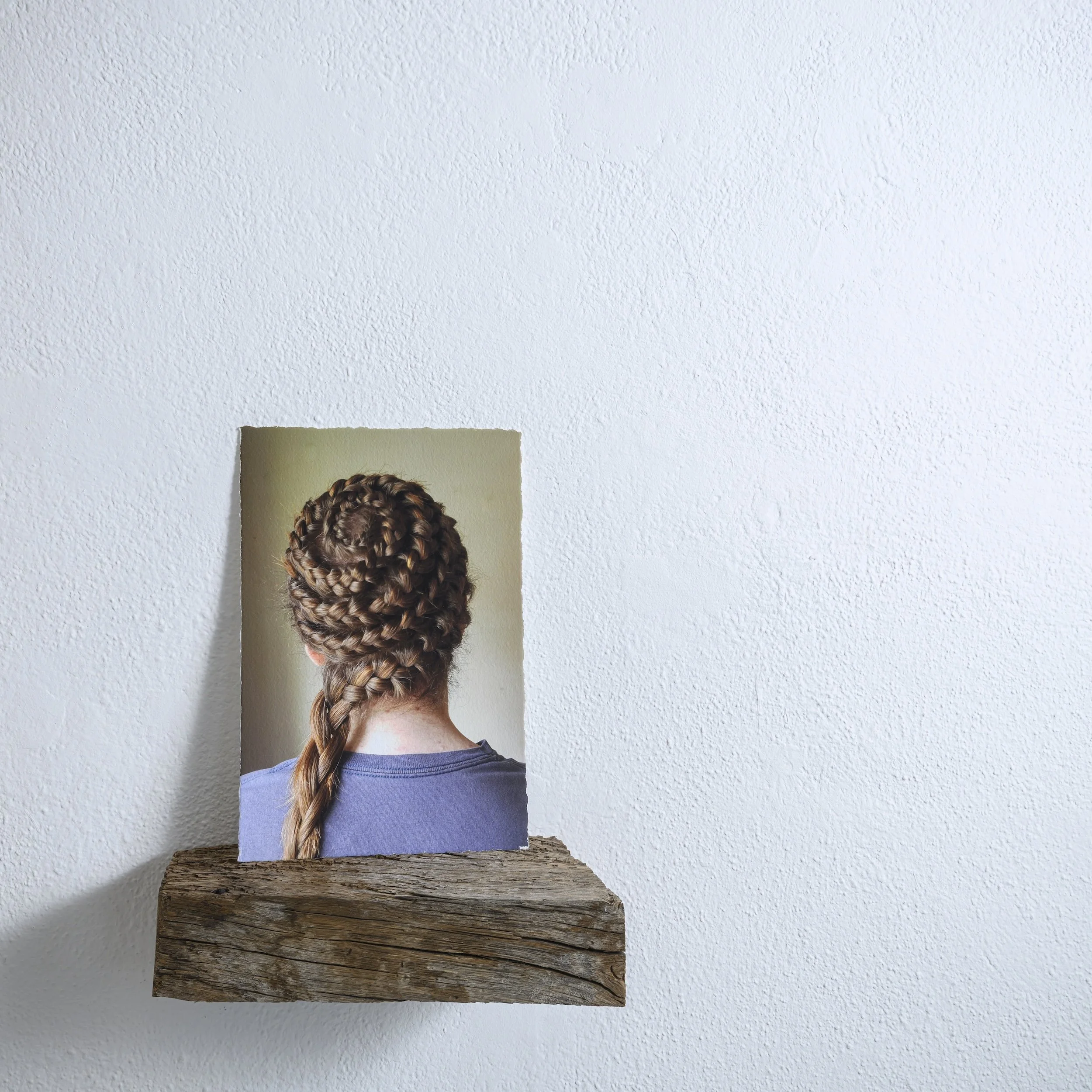
This neolithic braiding is employed in several of the smaller works in the studio, using soft rushes, and you can feel the rhythm in the pieces. ‘While I love weaving willow, I don’t like to use hard basketry in my artwork; I prefer the soft rushes. The weaving process is rhythmic, meditative … This process has been helpful in finding a place here, in finding a home.’ Retaining elements of the process is as important as the result. ‘What I’m trying to do is to find a place of serenity, of belonging’, says Christine. A photograph of her son’s hair, impressively braided in spiral is titled ‘Hold’. When we chat, she speaks of the endorphins, the closeness she felt braiding his hair, and uses the terms hold and home interchangeably, making me think of the containment and security of a safe space.
Robin Wall Kimmerer writes beautifully about the reciprocity of braiding in her preface to Braiding Sweetgrass:
Of course you can do it yourself—by tying one end to a chair, or by holding it in your teeth and braiding backward away from yourself—but the sweetest way is to have someone else hold the end so that you pull gently against each other, all the while leaning in, head to head, chatting and laughing, watching each other’s hands, one holding steady while the other shifts the slim bundles over one another, each in its turn. Linked by sweetgrass, there is reciprocity between you, linked by sweetgrass, the holder as vital as the braider.[1]
This lovely holding space recurs in To Hold, a work which combines soft rush and willow bark, contrasting the loose roll of willow bark with the tight braided material; the tight form of the roll with the loose form of the braided material. I saw the new moon rise with the old moon in her arms combines butcher’s twine, fisherman’s rope, mother’s hair. I ask, ‘Your mother or you as a mother?’ ‘Me as a mother’, she affirms.
Find some things to love looks to me on first impression like it is made of shoe leather, fore fronting the stitching. Sections of willow bark are stitched together in tight panels. Here, this pioneer species, at home in a wet boggy hollow, has proffered a dry skin, so that might look quite at home in an Australian desert. It’s a strong piece, reminiscent of a shield, almost ceremonial, and with a sense of the protective, but my eye is also drawn to the verticality of the lines. She has chosen not to weave with this material, most often favoured in Ireland as a ‘go-to’ for weaving. Instead, she has stripped the bark and used that as her material, a material often used as a natural remedy for pain and inflammation due to its salicin content.
Willow - also known as a treatment for loneliness [2] - is found again in Peel, where Christine has stripped the willow and dressed it with the snakeskin. When she talks about this process, she speaks of how wrapping the willow in snakeskin made her want to vomit. ‘I really wanted to use snake-skin, the desire was there, I felt it underlined so much of the aesthetic running through my work, but it made me so nauseous.’ ‘Leave them alone’, said her brother, ‘maybe you shouldn’t be messing with the snakes, maybe they don’t want to be in Ireland.’
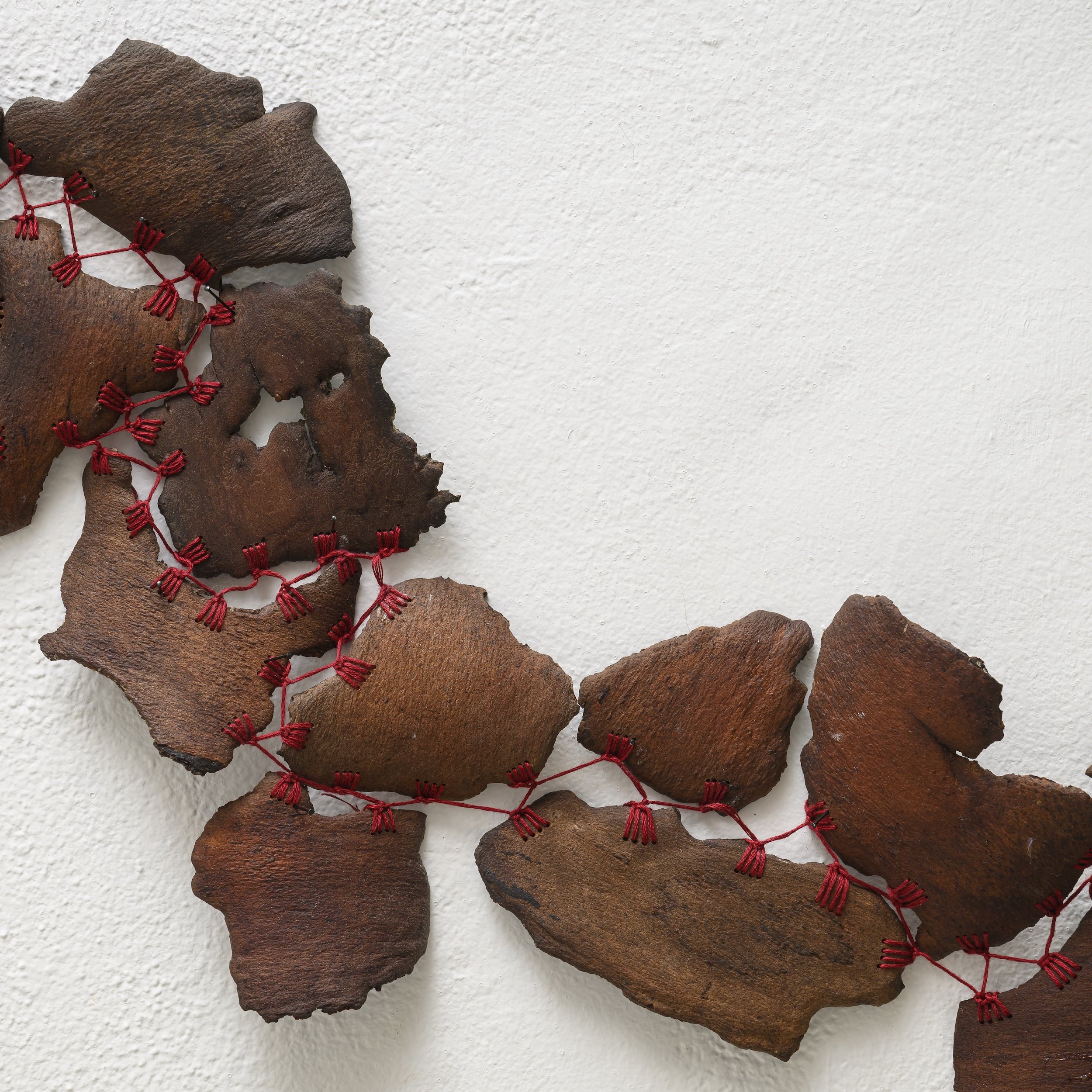
Shingleback Creek, 2025, oiled sprucebark and cotton thread. Photograph by Micheal McLaughlin
‘I want to reference scale and skin, earth and water’, she says. Another piece that feels scaly is in process when I visit the studio. The bark-flakes of the Sitka spruce are hard, dry, dark and have a lovely curve which fits beautifully in your hand. They don’t feel at home in this landscape, which makes sense, given the incongruity of Sitka Spruce plantations on our blanket bogs, their jarring straight lines, the toxicity of their acid run-off to our water-ways. Christine is in the process of stitching these ‘flakes’ together with a dark red embroidery thread. It looks to me like a suit of armour in the making. This is Shingleback Creek. A shingleback is a lizard and this creek is fictitious. I wonder if it’s the four-pronged embroidery stitches which are referencing the lizard, or is it the scaly curve of the piece? ‘In Australia, we don’t lose our leaves, we lose our bark’, she says ‘like a snake shedding skin’.
I suppose water – or lack of - is an elephant in the room, and the referencing of water, fictitious or real recurs in Water License/The Dry, a work woven of New Zealand Flax. The piece shares qualities with domestic objects, floor mats or table mats, woven in an expanding spiral, but this one is riven and bent, so that it becomes quite sculptural. Into this, she has stitched the water course at home.
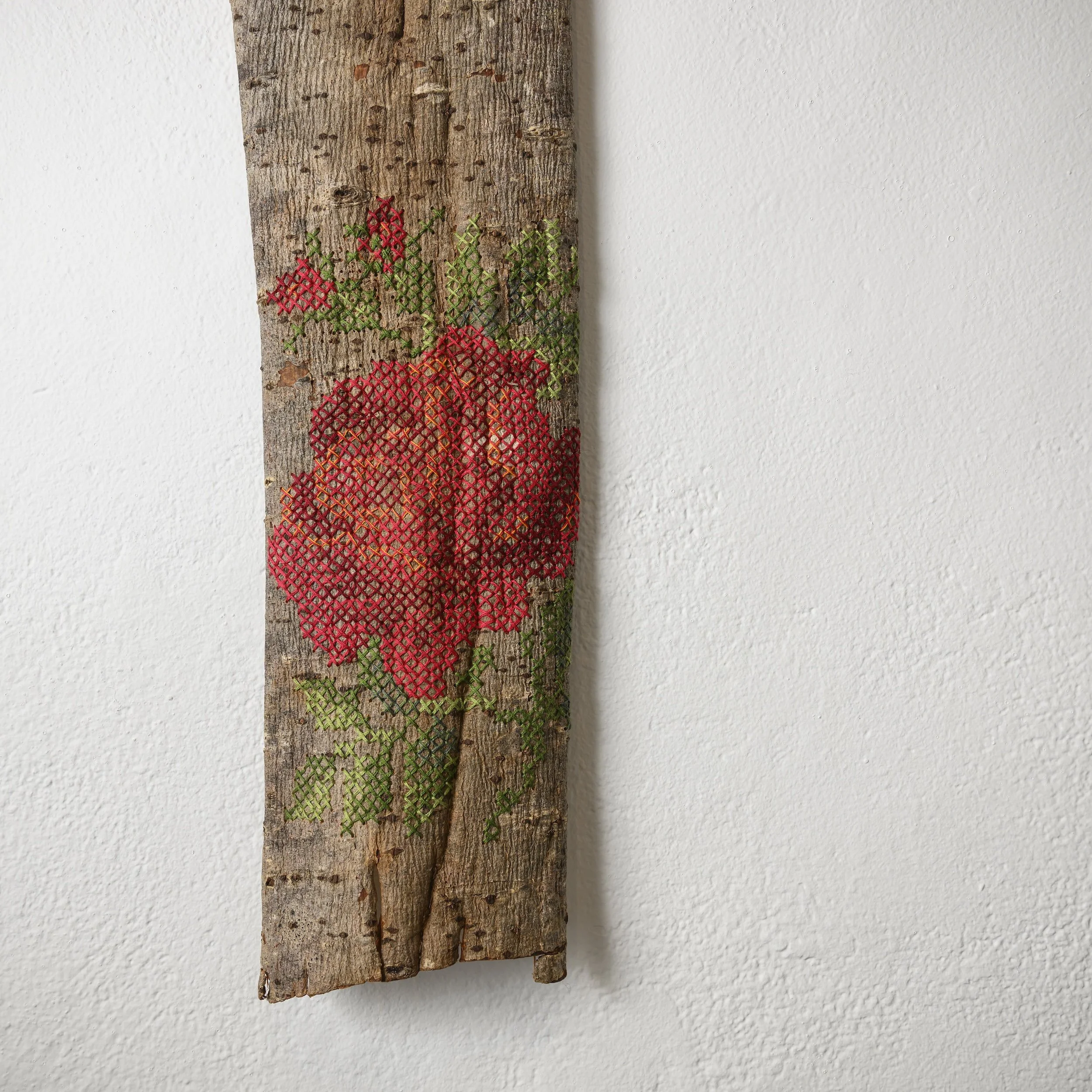
No Farmer’s Daughters, 2025, willow bark and cotton thread, photograph by Michael McLaughlin
The indigenous weaving practices of her other works meet Victorian embroidery in Colonial cross stitch (no farms no farmers daughters and existential dissonance) Prickly Pear plants were introduced to Australia by the colonists of the First Fleet in 1788, together with the cochineal beetle. Red, sourced from the beetle, was the colour of authority and power, and the British army’s ‘redcoat’ uniforms became synonymous with the exercise of power. The beetle didn’t survive but the prickly pear thrived, becoming classified as a noxious weed, and so the introduction of Cactoblastis cactorum, moths indigenous to a small area of Argentina, to control the Prickly Pear. This is often cited as one of the best examples of biological weed control but is redolent of colonialism and the perils of invasive species impacting on biodiversity loss.
My first encounter with Christine’s work was with some of her wine drawings, as we exhibited them in Interface several years ago. I suppose they are always bound to be a good conversation starter... ‘That must have been a good year! Did you drink the rest, haha?’ etc Indeed she acknowledges that conversation is a way into the work. That’s the way in, then she invites the viewer to sit with the piece, in stillness, and enter into the meditative state which she employed in the making of the works. The material is recurrent in her work. She likes the smell, likes the behaviour, the fact that it has its own agency and that the process feels collaborative. Interestingly, she speaks of how the wine making process was all about preservation, preservation of the grape, the irony being that it makes memories false. The paintings are seemingly endless, hills upon hills, scales upon scales, fading and approaching. Her wine painting Earth. Skin. Scale. references the textures and the recurrent thematics running through the whole body of work.
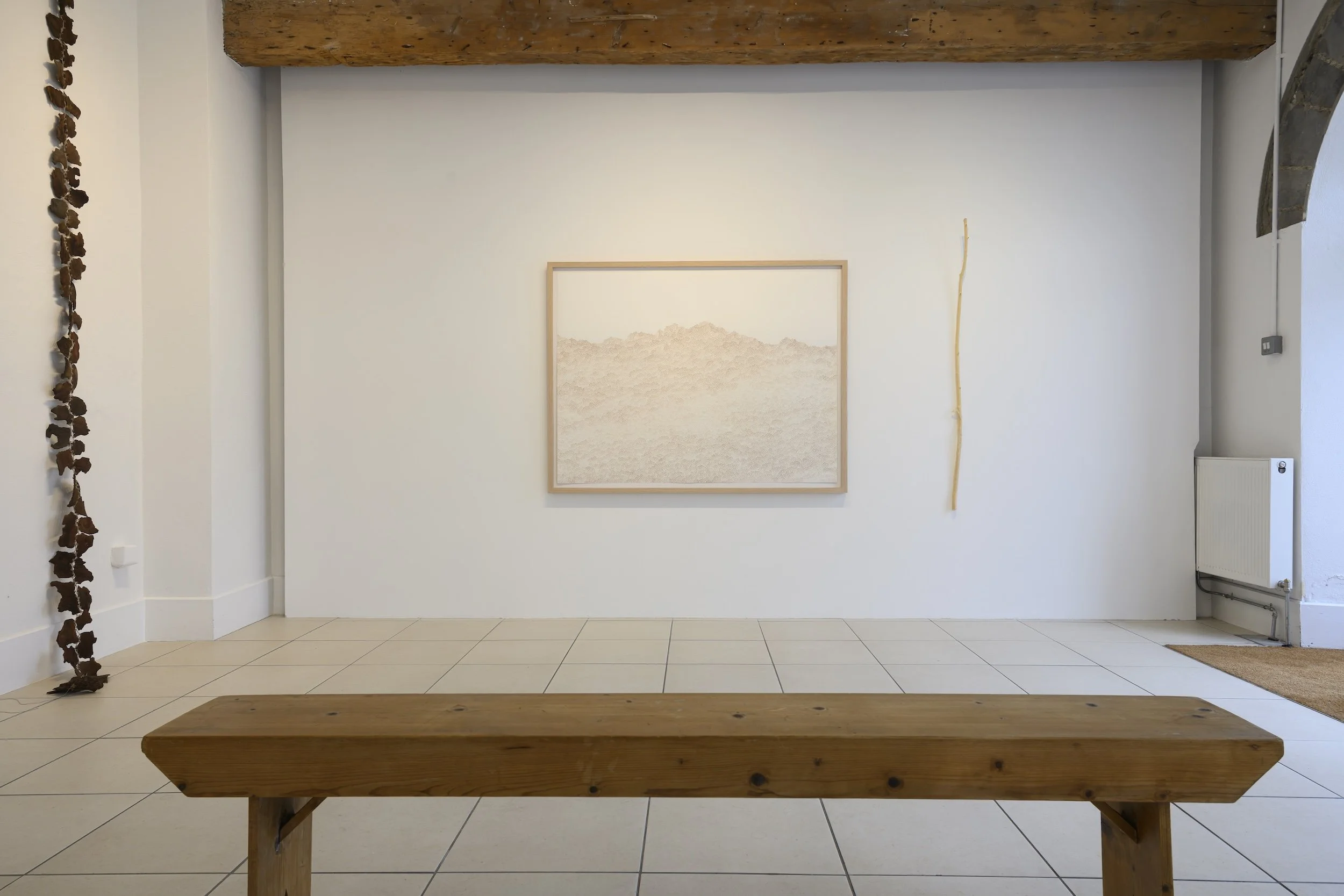
Rites of Homing, installation view. Tracks, 2025, spruce bark & waxed linen; Current 2024, red wine on paper; Shed, 2025, willow & snakeskin
starter... ‘That must have been a good year! Did you drink the rest, haha?’ etc Indeed she acknowledges that conversation is a way into the work. That’s the way in, then she invites the viewer to sit with the piece, in stillness, and enter into the meditative state which she employed in the making of the works. The material is recurrent in her work. She likes the smell, likes the behaviour, the fact that it has its own agency and that the process feels collaborative. Interestingly, she speaks of how the wine making process was all about preservation, preservation of the grape, the irony being that it makes memories false. The paintings are seemingly endless, hills upon hills, scales upon scales, fading and approaching. Her wine painting Earth. Skin. Scale. references the textures and the recurrent thematics running through the whole body of work.
Christine Prescott has now been living in Ireland for twenty years. To a great extent it is her home, it is the home of her two sons. She has an active practice in forest bathing, a practice which enables her to recreate the playing with plants of her childhood, to recreate a sense of home in nature. The materials of her artistic practice are the materials of this place: willow, rushes and spruce. The messy sensibility of the Irish landscape, however, is not found in this work. She has transformed the stuff of hedgerows into artworks of love and ceremony, full of rhythm, process and detail.
In a time of ecological uncertainty and increasing migration, when more people are looking to find their home in a new place, it is this concentration of small, meditative steps which keep us sane and rooted. I return to the words of Robin Wall Kimmerer to speak of our relationship with place.
It was through her actions of reciprocity, the give and take with the land, that the original immigrant became indigenous. For all of us, becoming indigenous to a place means living as if your children’s future mattered, to take care of the land as if our lives, both material and spiritual, depended on it. [3]
Alannah Robbins is an interdisciplinary artist working between Ireland and Sweden. She is founder and director of Interface Inagh.
[1] Wall Kimmerer, Robin: Braiding Sweetgrass, Penguin, 2020, ix
[2] Beresford-Kroeger, Diana: To Speak for the Trees, Timber Press, 2024
[3] Wall Kimmerer, Robin: Braiding Sweetgrass, Penguin, 2020, p9